US Stocks, Hong Kong Stocks, and China A-Shares Trading Hours and Rules Comparison



Image Source: pexels
For global investors, understanding the core rules of different stock markets is crucial. The table below quickly summarizes the differences between mainland China A-shares, Hong Kong stocks, and US stocks in several key dimensions.
| Market | Trading Hours (Beijing Time) | Price Limit Restrictions | Trading and Settlement System |
|---|---|---|---|
| Mainland China A-Shares | Trading days 9:30-11:30, 13:00-15:00 | Yes (usually ±10%) | T+1 trading / T+1 settlement |
| Hong Kong Stocks | Trading days 9:30-12:00, 13:00-16:00 | No | T+0 trading / T+2 settlement |
| US Stocks | Daylight saving: 21:30-next day 4:00 (incl. pre/after-hours) | No individual stock limits | T+0 trading / T+1 settlement |
💡 Quick Overview: The table above shows the basic framework of the three major markets. For example, US stock opening times completely differ from A-shares, and trading and settlement rules also vary significantly.
This article will break down these core rules in detail, helping investors fully understand how each major market operates.
Key Points
- A-shares, Hong Kong stocks, and US stocks have different trading hours; investors need to choose the market that fits their schedule.
- A-shares have price limits; Hong Kong and US stocks have no individual price limits but other risk control mechanisms.
- Hong Kong and US stocks support same-day buying and selling (T+0 trading); A-shares require waiting until the next day to sell (T+1 trading).
- A-shares buy in “lots,” with 1 lot being 100 shares; Hong Kong stocks’ lot sizes vary; US stocks can buy just 1 share, with lower entry barriers.
- Understanding different market rules helps investors better manage risks and make informed investment choices.
Trading Hours Comparison: A-Shares, Hong Kong Stocks, and US Stocks
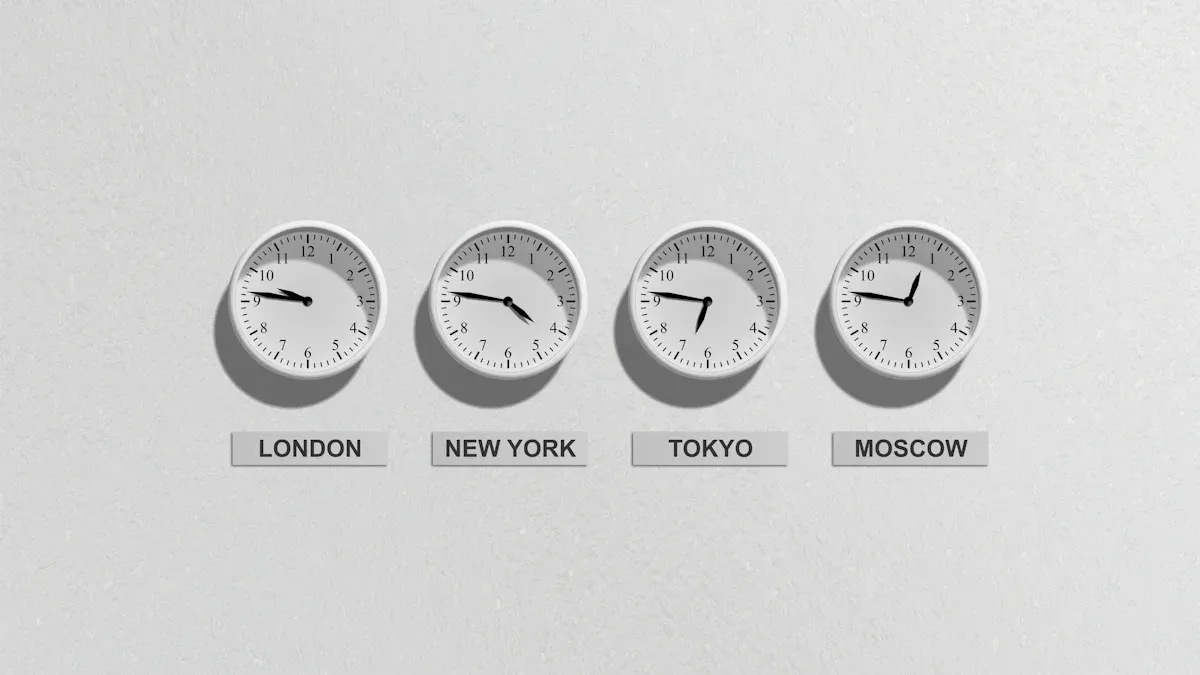
Image Source: pexels
Different markets’ trading hour arrangements directly impact investors’ strategies and daily routines. Understanding these differences is the first step in global asset allocation.
A-Shares Trading Hours: Fixed Daytime Sessions
Mainland China A-shares have very regular trading hours, strictly following Beijing time.
- Call Auction: Morning 9:15 - 9:25; Afternoon 14:57 - 15:00
- Continuous Trading: Morning 9:30 - 11:30; Afternoon 13:00 - 15:00
A-shares have a fixed midday break, with trading fully concentrated in Asian timezone daytime.
Hong Kong Stocks Trading Hours: Includes Midday Break and Pre-Open
Hong Kong stocks have slightly longer hours than A-shares, also with a midday break. Its unique feature is the “pre-open” session.
Pre-Open Session (9:00 - 9:30) This session determines stock opening prices. Investors can enter auction orders, and the system matches buy/sell orders to form a fair opening price.
Regular trading hours are Beijing time morning 9:30 to 12:00, and afternoon 13:00 to 16:00.
US Stocks Opening Times: Regular, Pre-Market, and After-Hours
US stock opening times are nighttime for Asian investors. It also involves daylight saving and standard time concepts, causing US stock opening times to adjust annually.
| Time Type | 2025 Start Date | 2025 End Date |
|---|---|---|
| US Daylight Saving Time | March 9 | November 2 |
| US Standard Time | November 2 | March 8, 2026 |
This directly affects US stock opening in Beijing time.
- Daylight Saving Time: Regular trading Beijing time 21:30 - next day 4:00.
- Standard Time: Regular trading Beijing time 22:30 - next day 5:00.
Additionally, US markets offer pre-market (Pre-market) and after-hours (After-hours) trading, greatly extending the trading window. Investors need to accurately track actual US stock opening times based on seasonal changes.
Risk Control Mechanisms: Price Limits and Circuit Breakers
Image Source: pexels
To maintain market stability and control risks, the three markets adopt completely different mechanisms. These rules directly affect stock price volatility and investor potential risks.
A-Shares: Individual Stock Price Limits
Mainland China A-shares mainly control risks by setting daily price limits for individual stocks. This “upper limit” and “lower limit” system provides a buffer. However, limits vary by board.
| Market Board | Daily Price Fluctuation Limit |
|---|---|
| Main Board, B-Shares, Funds | ±10% (ST stocks under special treatment ±5%) |
| STAR Board, ChiNext (first 5 trading days after listing) | No price limits |
| STAR Board, ChiNext (from 6th trading day) | ±20% |
This mechanism aims to curb excessive speculation in single stocks but can cause liquidity issues in extreme conditions.
Hong Kong Stocks: No Individual Price Limits
Unlike A-shares, Hong Kong stocks have no price limits on individual stocks. Theoretically, a stock’s price can multiply or lose most value in one day. This high volatility brings opportunities but also huge risks.
To handle sudden extreme swings, Hong Kong introduced the Volatility Control Mechanism (VCM).
Volatility Control Mechanism (VCM) If a Hang Seng or H-share index constituent swings over ±10% in 5 minutes, it triggers a 5-minute “cooling-off period.” During this, trading is restricted to a fixed price range to help the market digest information and restore order.
US Stocks: Index Circuit Breaker Mechanism
US markets do not limit individual stocks but use an index-wide circuit breaker tied to the S&P 500, giving investors time to think during panic selling.
The circuit breaker has three levels:
| Breaker Level | S&P 500 Decline | Trading Halt Measure |
|---|---|---|
| Level 1 | 7% | Halt trading for 15 minutes |
| Level 2 | 13% | Halt trading again for 15 minutes |
| Level 3 | 20% | Terminate trading for the day |
This protects overall market stability, not single stocks. Thus, even without index breakers, individual stocks can still swing sharply.
Trading and Settlement Rules: T+0 vs T+1
Trading and settlement are two core aspects of stock transactions. “T” stands for Trade Day, and the number after “+” is days needed for delivery. This rule directly determines capital efficiency and trading flexibility.
A-Shares: T+1 Trading and Settlement
Mainland China A-shares strictly follow T+1 trading and settlement.
- T+1 Trading: Stocks bought today cannot be sold until the next trading day.
- T+1 Settlement: Share and fund delivery completes on the first business day after trade.
This restricts intraday trading, requiring longer-term thinking.
Hong Kong Stocks: T+0 Trading with T+2 Settlement
Hong Kong rules are unique, combining flexible trading with longer settlement.
First, Hong Kong implements T+0 trading. This allows unlimited same-day buy/sell of stocks, enabling various short-term strategies.
However, Hong Kong uses T+2 settlement for funds and shares.
Trading vs. Settlement “Trading” is the moment you click buy/sell in the broker app—trade executes instantly. “Settlement” is backend share transfer and fund movement. In Hong Kong, this takes two trading days.
This means both buyers and sellers finalize delivery on the second business day after trade (T+2).
US Stocks: T+0 Trading with T+1 Settlement
US markets balance trading flexibility and capital efficiency well.
Like Hong Kong, US stocks allow T+0 trading, with no limit on same-day trades.
For settlement, US uses T+1. Funds and shares deliver on the next business day after trade. Compared to Hong Kong’s T+2, this faster cycle allows quicker capital turnover.
Trading Thresholds: Units and Currencies
Entering any stock market, investors first need to know basic trading units and pricing currencies. This determines minimum investment and relates to currency exchange operations.
A-Shares: Lots in RMB
Mainland China A-shares have highly standardized units.
- Trading Unit: Buys must be in “lots,” 1 lot fixed at 100 shares. Sells can include odd lots.
- Pricing Currency: All A-shares quoted and traded in RMB (CNY).
This uniformity simplifies calculations, but high-priced stocks require minimum “100 shares x price” investment.
Hong Kong Stocks: Lots in HKD
Hong Kong also uses “lots” in HKD. However, lot definitions differ completely from A-shares. Lot sizes are set by listed companies, varying from dozens to tens of thousands of shares.
💡 Variable Lot Sizes Companies can adjust lots as needed. For example, BYD changed its H-shares lot from 500 to 100 shares to lower barriers. Conversely, some raise lots significantly during privatization.
Different companies’ lot sizes vary greatly, directly affecting minimum investment.
| Company Name | Stock Code | Lot Size |
|---|---|---|
| HSBC Holdings | 0005 | 400 shares |
Due to rights issues or bonus shares, accounts may hold odd lots. Odd lot trading rules are more complex than A-shares, usually via special systems, with potentially worse prices than full lots.
US Stocks: Shares in USD
US markets are most flexible in thresholds.
- Trading Unit: Minimum unit is 1 share. Investors can buy/sell just 1 share.
- Pricing Currency: All stocks quoted/traded in USD.
Further, many brokers support fractional shares. This allows buying by dollar amount, not shares. For example, even at $1,000/share, invest $20 for 0.02 shares.
This greatly lowers barriers, letting ordinary investors own parts of high-priced stocks like Google or Amazon. Investors can conveniently exchange funds to USD via platforms like Biyapay and participate in fractional trading, building diversified portfolios with small amounts.
A-shares, Hong Kong stocks, and US stocks each have unique features in trading hours, risk controls, and capital efficiency. No market is absolutely superior; choice depends on matching investors’ habits, risk preferences, and schedules. For example, US stock opening times require some to use pre/after-hours for timezone differences.
💡 Core Advice Before entering any market, investors should fully understand its unique rules and develop corresponding capital and risk management strategies to handle different dynamics.
FAQ
Do all three markets close on holidays?
Yes, all three follow their respective regional statutory holidays. Mainland China A-shares close on Chinese holidays, Hong Kong stocks on Hong Kong public holidays, and US stocks on US federal holidays. Investors need to monitor different markets’ holiday schedules.
What are the special advantages of investing in US stocks?
Investors can access top global tech and consumer companies via US stocks. Trading unit is 1 share, with very flexible barriers. Users can conveniently exchange funds to USD via Biyapay and easily participate in the US market.
What exactly does “T+0” trading mean?
T+0 means investors can sell stocks bought on the same trading day, enabling intraday short-term operations. Hong Kong and US markets support T+0 trading, while mainland China A-shares use T+1—stocks bought today can only be sold the next trading day.
What is the difference between A-shares’ “lot” and US stocks’ “share”?
A-shares’ “lot” is a fixed buy unit, 1 lot equals 100 shares. US stocks’ “share” is the minimum unit, allowing buys/sells of just 1 share. This difference directly affects minimum per-trade investment, making US stocks’ barriers lower.
*This article is provided for general information purposes and does not constitute legal, tax or other professional advice from BiyaPay or its subsidiaries and its affiliates, and it is not intended as a substitute for obtaining advice from a financial advisor or any other professional.
We make no representations, warranties or warranties, express or implied, as to the accuracy, completeness or timeliness of the contents of this publication.
Related Blogs of
Annual Review: Best Performing US Stock ETFs in 2026 and the Logic Behind Them

Micro Dow, Micro Nasdaq, Micro S&P Futures Comprehensive Comparison – Helping You Find the Best Trading Choice


Focusing on AI and Semiconductors: In-Depth Analysis of 10 Leading Future US Tech Stocks


A Blessing for Small Investors: Finding the Lowest Trading Cost US Stock Brokers
Choose Country or Region to Read Local Blog
 Australia
 Austria
 Belgium
 Canada
 Cyprus
 Czech Republic
 Denmark
 Estonia
 Finland
 France
 Germany
 Greece
 Hong Kong
 India
India Indonesia
 Ireland
 Italy
Italy Japan
Japan Latvia
 Lithuania
 Luxembourg
 Malaysia
 Malta
Malta Morocco
 Nepal
Nepal Netherlands
 New Zealand
 Norway
 Pakistan
 Philippines
 Poland
 Portugal
 Romania
 Singapore
 Slovakia
 Slovenia
 South Africa
 South Korea
 Spain
Spain Sweden
 Thailand
 The United States
 Turkey
 United Arab Emirates
 United Kingdom
 Vietnam
Contact Us




BIYA GLOBAL LLC is a licensed entity registered with the U.S. Securities and Exchange Commission (SEC No.: 802-127417); a certified member of the Financial Industry Regulatory Authority (FINRA) (Central Registration Depository CRD No.: 325027); regulated by the Financial Industry Regulatory Authority (FINRA) and the U.S. Securities and Exchange Commission (SEC).
BIYA GLOBAL LLC is registered with the Financial Crimes Enforcement Network (FinCEN), an agency under the U.S. Department of the Treasury, as a Money Services Business (MSB), with registration number 31000218637349, and regulated by the Financial Crimes Enforcement Network (FinCEN).
BIYA GLOBAL LIMITED is a registered Financial Service Provider (FSP) in New Zealand, with registration number FSP1007221, and is also a registered member of the Financial Services Complaints Limited (FSCL), an independent dispute resolution scheme in New Zealand.