Complete Guide to US Stock Index Investing: Dow Jones for Stability, Nasdaq for High Growth – Which One Suits You?




Image Source: unsplash
Want to invest in US stocks, but confused by US stock indices like Dow Jones, Nasdaq, and S&P 500?
In simple terms: Choose Nasdaq for high growth, S&P 500 for steady market tracking, and Dow Jones for large companies. For example, the S&P 500 achieved a total return of around 12-13% in 2025 (as of December), reflecting its market representativeness.
The table below helps investors quickly understand the core differences among the three major indices.
| Index Name | Investment Style | Core Features | Suitable For |
|---|---|---|---|
| Nasdaq 100 | 🚀 High Growth | Dominated by tech stocks, high volatility | High-risk tolerance investors |
| S&P 500 | 📈 Market Benchmark | Broad coverage, balanced sectors | Almost all investors |
| Dow Jones | 🛡️ Stable Blue-Chip | 30 industry giants, long history | Conservative investors |
Key Takeaways
- The Nasdaq 100 index is suitable for investors seeking high growth; it primarily invests in technology companies but has relatively high volatility.
- The S&P 500 index represents the overall performance of the US stock market and is suitable for most investors, providing steady average market returns.
- The Dow Jones index includes 30 large mature companies and is suitable for conservative investors, focusing on stability and long-term value preservation.
- Investors can choose the most suitable US stock index based on their risk tolerance and investment goals.
- By purchasing ETFs, investors can easily and quickly invest in these US stock indices, achieving risk diversification and low-cost investment.
Nasdaq Index: The Aggressive Choice for High Growth

Image Source: unsplash
The Nasdaq 100 index is a global benchmark for technological innovation. It focuses on high-growth potential, making it a highly aggressive choice in investment portfolios.
Features: Tech-Driven High Growth
The standout feature of the Nasdaq 100 index is its exceptional growth potential. For example, the index has achieved significant gains since 2024, fully demonstrating its aggressive capabilities. This high growth primarily stems from its heavy concentration in the technology sector, covering cutting-edge areas like artificial intelligence, semiconductors, and software. The index has a total market capitalization of approximately $33-38 trillion (recent estimates), gathering the world’s most innovative companies.
A key characteristic is that the Nasdaq 100 index excludes financial companies. This rule makes it more focused on high-growth sectors like technology and consumer, but it also amplifies market volatility. In the long term, its returns are quite impressive.
| Time Period | Nasdaq 100 Annualized Return (Including Dividends, via QQQ) |
|---|---|
| 10 Years | Around 15-18% |
| 5 Years | Around 15-20% |
Target Investors: Suitable for High-Risk Tolerance Investors
High returns often come with high volatility. The characteristics of the Nasdaq 100 index make it more suitable for investors with higher risk tolerance.
Historical data shows that the volatility of the Nasdaq 100 index is typically higher than the market average. In recent years, its rolling one-year volatility has been higher than the S&P 500 on average.
| Index | Annualized Volatility |
|---|---|
| Nasdaq 100 | Around 23% |
| S&P 500 | Around 20% |
Therefore, investors choosing this index need a long-term investment horizon and mental preparedness to withstand short-term dramatic market fluctuations in exchange for long-term high growth potential.
How to Invest: Investing in Nasdaq 100 ETFs
For ordinary investors, the most direct way to participate is by investing in ETFs that track the Nasdaq 100. The most well-known and highest-volume product on the market is Invesco QQQ Trust (QQQ). Additionally, Invesco offers a lower-cost alternative, Invesco NASDAQ 100 ETF (QQQM).
QQQ has an expense ratio of 0.20%, while QQQM has a lower expense ratio of 0.15%. Investors can conveniently purchase such ETF products through digital asset platforms like Biyapay, easily allocating to this powerful US stock index.
S&P 500 Index: The Most Noteworthy US Stock Index
If the Nasdaq 100 is a sharp “spear,” then the S&P 500 index is the balanced “core position” in an investment portfolio, both offensive and defensive. It is widely regarded as the best single gauge of US stock market performance and the most noteworthy US stock index.
Features: Accurately Reflects Overall US Market Performance
The core value of the S&P 500 index lies in its broad market representativeness. The index tracks approximately 500 of the largest US companies by market capitalization, covering about 80% of the total market capitalization of US stocks. Unlike the Nasdaq, which is heavily concentrated in tech stocks, the S&P 500 has a very balanced sector distribution, covering all major economic areas such as information technology, healthcare, finance, and consumer. This allows it to most accurately reflect the health of the overall US economy and market trends.
From a risk-adjusted return perspective, the S&P 500 provides steady returns. Although its Sharpe ratio over the past decade has been moderate, its diversified composition effectively spreads risk across individual sectors, avoiding excessive volatility and making it an ideal cornerstone for long-term investment.
Target Investors: Suitable for Almost All Types of Investors
The universality of the S&P 500 index makes it an ideal choice for nearly all investors, whether beginners or experienced veterans. Warren Buffett has repeatedly publicly recommended that ordinary investors choose S&P 500 index funds.
In his letter to trustees, Buffett clearly advised: “Put 10% of cash in short-term government bonds and 90% in a very low-cost S&P 500 index fund.”
The logic behind this advice is that by investing in the S&P 500, investors can easily obtain average returns from the US market, avoiding the complexity and risks of individual stock picking. For investors seeking steady growth without taking excessive risk, it is a perfect starting point.
How to Invest: Investing in S&P 500 ETFs
The most convenient way to invest in the S&P 500 index is by purchasing ETFs that track it. The products with the best liquidity and largest scale on the market include:
| ETF Name | Assets Under Management (AUM) |
|---|---|
| Vanguard S&P 500 ETF (VOO) | $823.29 B |
| iShares Core S&P 500 ETF (IVV) | $734.98 B |
| SPDR S&P 500 ETF Trust (SPY) | $707.15 B |
Expense ratio is a key consideration when choosing. VOO and IVV have highly competitive fees, while SPY is slightly higher.
| ETF | Expense Ratio |
|---|---|
| SPY | 0.0945% |
| VOO | 0.03% |
| IVV | 0.03% |
Investors can conveniently purchase low-cost ETFs like VOO and IVV through digital asset platforms such as Biyapay, incorporating the growth drivers of the US economy into their investment portfolios.
Dow Jones Index: The Defensive Choice for Stable Blue-Chips

Image Source: pexels
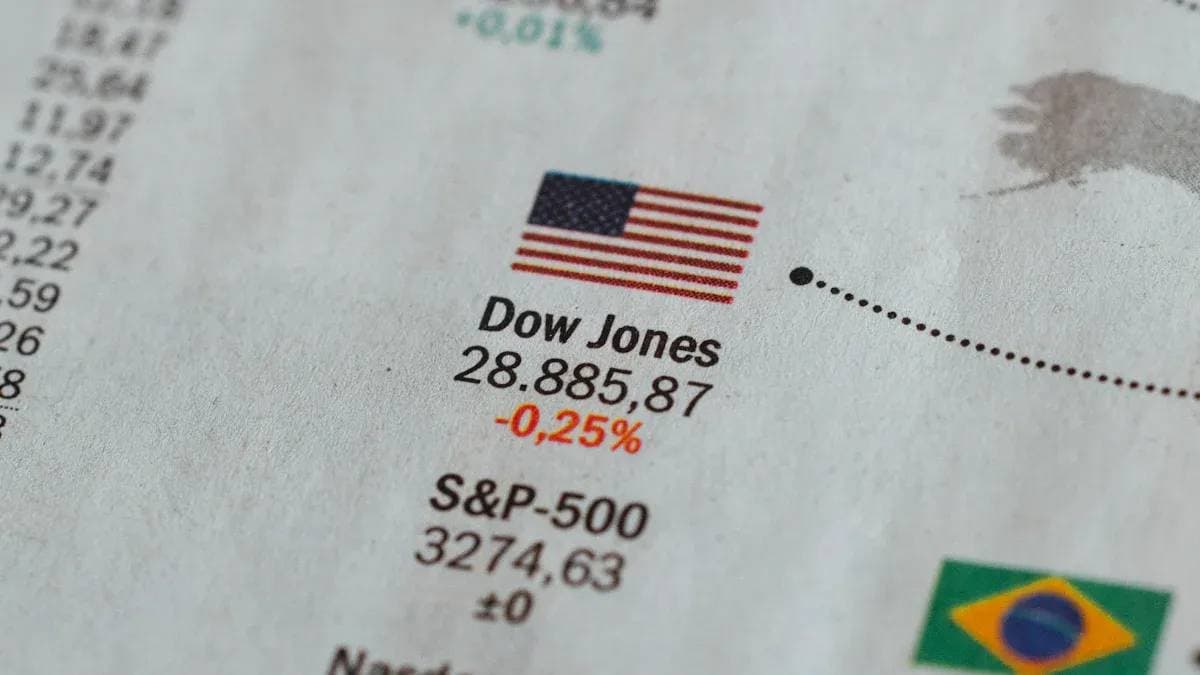
If Nasdaq is the offensive “spear” and S&P 500 is the balanced “core position,” then the Dow Jones Industrial Average (DJIA) is the solid “shield” in an investment portfolio. It represents the most mature and stable blue-chip forces in the US economy and is the defensive choice for steady investors.
Features: Long-History 30 Industry Giants
The Dow Jones index has a long history, first launched on May 26, 1896, making it one of the oldest and most watched stock indices in the world. Unlike the S&P 500, which includes 500 companies, the Dow Jones consists of only 30 carefully selected US blue-chip companies.
The S&P Dow Jones Indices Committee has strict selection criteria; selected companies must be reputable, financially sound, and influential mature enterprises in their industries. Its components cover multiple key areas of the US economy.
| Company Name | Sector |
|---|---|
| Apple | Technology |
| Johnson & Johnson | Healthcare |
| JPMorgan Chase & Co | Finance |
| McDonald’s | Food Service |
| Boeing | Aerospace/Industrial |
A unique aspect of the Dow Jones index is its "price-weighted" calculation method. This means higher-priced stocks have greater influence on the index, while total market capitalization is secondary. This contrasts sharply with the S&P 500’s “market-cap weighted” method.
- Price-Weighted (Dow Jones): Higher-priced stocks have greater impact on index changes.
- Market-Cap Weighted (S&P 500): Larger market-cap companies have greater impact on index changes.
Target Investors: Suitable for Stability-Preferring Conservative Investors
The composition of the Dow Jones index makes it more suitable for conservative investors with lower risk preferences, seeking stable cash flows and long-term capital preservation. These blue-chip companies are typically mature industry leaders with stable profitability and dividend histories, better able to withstand economic cycle fluctuations.
Of course, stability does not mean no risk. In major market crises, the Dow Jones index will also experience significant pullbacks.
For example, during the COVID-19 crisis in March 2020, the index dropped about 26% in just four trading days. However, the strong resilience of these high-quality blue-chips allowed it to recover steadily during market rebounds, regaining lost ground by the end of 2020 and reaching new highs.
This characteristic makes it an ideal choice for building defensive investment portfolios.
How to Invest: Investing in Dow Jones Index ETFs
For investors wanting to allocate to this classic US stock index, the most direct way is to purchase ETFs that track the Dow Jones. The largest and most liquid product on the market is SPDR Dow Jones Industrial Average ETF (DIA).
DIA has assets under management (AUM) of up to around $34-35 billion, with an expense ratio of 0.16%. For investors wanting to include America’s top blue-chip companies in their portfolios, this is a convenient and efficient choice. Investors can easily purchase ETF products like DIA through platforms like Biyapay, achieving one-click allocation to stable blue-chips.
Investors should choose the appropriate US stock index based on their own situation. Nasdaq is the offensive “spear,” Dow Jones is the defensive “shield,” and S&P 500 is the balanced “core position.” There is no good or bad in investment choices—only suitability.
| Index Name | 10-Year Annualized Return |
|---|---|
| S&P 500 | Around 12-13% |
| Dow Jones | Around 10-11% |
Clearly defining your investment goals, risk preferences, and investment horizon is crucial.
Now, start your investment journey!
- Choose a brokerage account and deposit funds.
- Research and decide on the ETFs you want to buy.
- Search for the ticker on the broker platform and place an order.
FAQ
Which of the three major indices should I choose?
Investors’ choices should match their investment goals.
Aggressive investors seeking high growth can choose Nasdaq 100. Conservative investors preferring stability and defense can choose Dow Jones. Steady investors wanting market average returns should choose S&P 500 as the ideal option.
What is an ETF? Why invest through ETFs?
An ETF (Exchange-Traded Fund) is a fund that trades on exchanges like stocks. Investing in indices through ETFs offers three core advantages:
- Risk Diversification: Buy a basket of stocks at once.
- Low Cost: Management fees are typically lower than traditional funds.
- Convenient Trading: As easy and quick as trading individual stocks.
Which index has the lowest risk?
The Dow Jones index is generally considered to have relatively lower risk. It consists of 30 mature blue-chip companies with stable operations, better able to withstand economic fluctuations.
Important Note: There is no zero-risk investment. Even the Dow Jones index can experience significant drops in extreme market conditions. Risk tolerance is a key factor to assess before investing.
*This article is provided for general information purposes and does not constitute legal, tax or other professional advice from BiyaPay or its subsidiaries and its affiliates, and it is not intended as a substitute for obtaining advice from a financial advisor or any other professional.
We make no representations, warranties or warranties, express or implied, as to the accuracy, completeness or timeliness of the contents of this publication.
Related Blogs of
Micro Dow, Micro Nasdaq, Micro S&P Futures Comprehensive Comparison – Helping You Find the Best Trading Choice


Master US Stock Trading Hours in One Article: Never Miss Pre-Market and After-Hours Opportunities


How to Choose US Major Indices: Pros and Cons Analysis of S&P 500, Dow Jones, and Nasdaq


Focusing on AI and Semiconductors: In-Depth Analysis of 10 Leading Future US Tech Stocks

Choose Country or Region to Read Local Blog
 Australia
 Austria
 Belgium
 Canada
 Cyprus
 Czech Republic
 Denmark
 Estonia
 Finland
 France
 Germany
 Greece
 Hong Kong
 India
India Indonesia
 Ireland
 Italy
Italy Japan
Japan Latvia
 Lithuania
 Luxembourg
 Malaysia
 Malta
Malta Morocco
 Nepal
Nepal Netherlands
 New Zealand
 Norway
 Pakistan
 Philippines
 Poland
 Portugal
 Romania
 Singapore
 Slovakia
 Slovenia
 South Africa
 South Korea
 Spain
Spain Sweden
 Thailand
 The United States
 Turkey
 United Arab Emirates
 United Kingdom
 Vietnam
Contact Us




BIYA GLOBAL LLC is a licensed entity registered with the U.S. Securities and Exchange Commission (SEC No.: 802-127417); a certified member of the Financial Industry Regulatory Authority (FINRA) (Central Registration Depository CRD No.: 325027); regulated by the Financial Industry Regulatory Authority (FINRA) and the U.S. Securities and Exchange Commission (SEC).
BIYA GLOBAL LLC is registered with the Financial Crimes Enforcement Network (FinCEN), an agency under the U.S. Department of the Treasury, as a Money Services Business (MSB), with registration number 31000218637349, and regulated by the Financial Crimes Enforcement Network (FinCEN).
BIYA GLOBAL LIMITED is a registered Financial Service Provider (FSP) in New Zealand, with registration number FSP1007221, and is also a registered member of the Financial Services Complaints Limited (FSCL), an independent dispute resolution scheme in New Zealand.