Understanding the FOMC: The Core of the Federal Reserve's Monetary Policy Decision-making



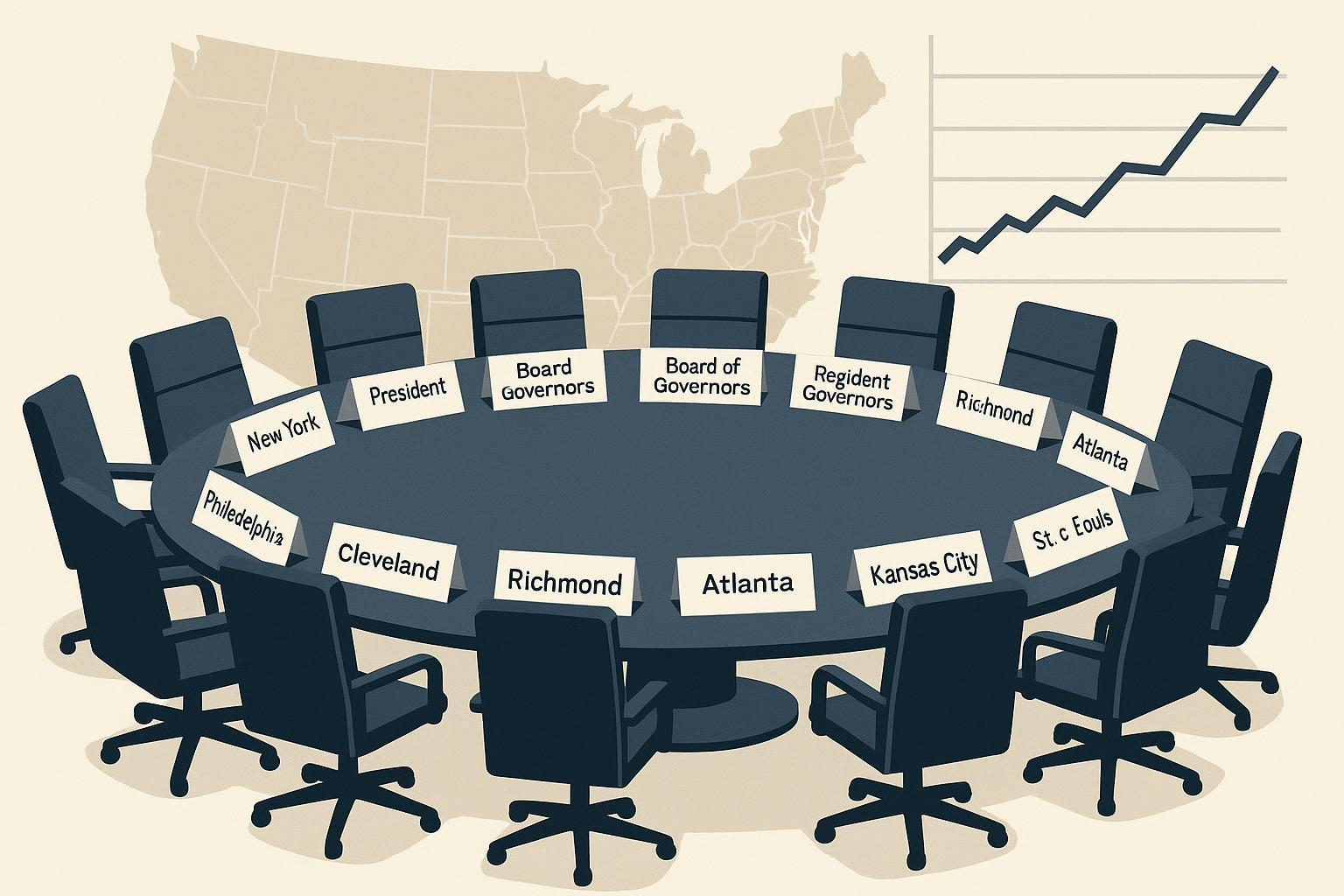
The FOMC (Federal Open Market Committee) is the core decision-making body within the Federal Reserve System responsible for formulating monetary policy, with the goals of achieving maximum employment, price stability, and promoting moderate long-term interest rates. You can think of it as the Federal Reserve’s “monetary policy council,” acting as the “main switch” that determines the direction of interest rates and liquidity conditions.
This article, based on official data up to 2025, provides a systematic understanding of the FOMC’s composition, how it holds meetings, the tools it uses, and how it impacts your loan rates, asset prices, and exchange rates.
Who Composes the FOMC and How Do They Vote?
The FOMC has 12 voting members: 7 Board of Governors members, the President of the New York Fed (a permanent voting member), and 4 other regional Fed presidents who rotate annually. Non-voting regional Fed presidents typically attend meetings and provide input but do not vote. This structure and procedure are based on the Federal Reserve’s authoritative “FOMC Rules and Authorizations (2025-01-28)”.
This design ensures a national perspective (Board of Governors) while incorporating regional economic insights (regional Feds), with the New York Fed responsible for executing market operations, giving its president a permanent voting role.
How Often Are Meetings Held, and When Is Information Released?
The FOMC typically holds 8 regular meetings per year, with additional meetings as needed. Immediately after each meeting, a “statement” and “implementation note” are released; approximately three weeks later, the “meeting minutes” are published. Quarterly meetings also include the release of the Summary of Economic Projections (SEP, including the “dot plot”) and a press conference by the Chair. You can check the schedule, statements, implementation notes, minutes, and projection materials on the Federal Reserve’s “Meeting Calendars and Information (2020–2027)” page (Fed, 2025).
What Policy Tools Does the FOMC Use?
Think of short-term interest rates as an “interest rate corridor.” The FOMC sets the “target range” for the federal funds rate and uses tools to keep market rates within this corridor:
- IORB (Interest on Reserve Balances) serves as the upper bound or near-upper-bound tool.
- ON RRP (Overnight Reverse Repurchase Agreement rate) provides the lower bound support.
- The New York Fed ensures effective implementation through open market operations (repos/reverse repos, Treasury and MBS transactions, etc.).
- Balance sheet reinvestment and redemption caps (part of the QE/QT framework) determine longer-term liquidity and yield curve effects.
After each meeting, the “implementation note” provides standardized operational parameters, such as IORB and ON RRP rates and SOMA reinvestment arrangements. Refer to the Federal Reserve’s “Implementation Note (2025-07-30)” press release page to understand how these technical instructions are executed.
What Are the SEP and “Dot Plot,” and What Are They Not?
The Summary of Economic Projections (SEP) compiles FOMC participants’ individual forecasts for growth, unemployment, inflation, and the policy rate path; the “dot plot” visually represents each member’s projections for the federal funds rate at specific future points. Key boundary: The dot plot reflects individual assessments, not a collective commitment or forward guidance, and these dots shift with new information. See the Federal Reserve’s “Projection Materials PDF Notes (Fed, 2025-09)”.
Why Does It Matter to Your Life and Markets?
FOMC decisions influence the economy through the chain of “policy rates → financial conditions → credit and asset prices → aggregate demand → employment and inflation.” Direct impacts include:
- Loans and credit cards: Higher policy rates typically increase short-term borrowing costs, with credit cards and some variable-rate loans being more sensitive.
- Mortgages and car loans: Long-term rates depend on market expectations for future inflation and policy paths, not always moving in lockstep with policy rates.
- Stock and bond markets: Valuations and yields are highly sensitive to changes in rate expectations, and FOMC communications alone can trigger price adjustments.
- Exchange rates: Higher short-term rates and tighter financial conditions may strengthen the domestic currency, and vice versa.
The Federal Reserve’s June 2025 “Monetary Policy Report” systematically explains this transmission framework and recent economic conditions, with relevant sections and illustrations.
How to Efficiently Follow FOMC Information?
Follow this “rhythm” for reading:
- The post-meeting “statement” clarifies the policy stance and economic assessment.
- The “implementation note” details execution parameters and technical specifics (IORB, ON RRP, reinvestment arrangements, etc.).
- Quarterly “projection materials (SEP/dot plot)” provide participants’ individual expectation distributions.
- The “meeting minutes” elaborate on discussion context and differing opinions.
- Combine the “Monetary Policy Report (MPR)” and Chair’s press conference for a comprehensive understanding.
Common Questions (FAQ)
- Q: Why didn’t my mortgage rate drop immediately after a Fed rate cut? A: Mortgages typically align with medium- to long-term rates, which depend on market pricing of future inflation, policy, and term premiums, not just current policy rates. Thus, changes may lag or differ in magnitude.
- Q: Is the “dot plot” a policy commitment? A: No. The dot plot reflects individual judgments, not a collective commitment, and adjusts with economic data and risk balance changes (see the 2025-09 projection materials notes above).
- Q: Why is the New York Fed’s role special? A: The New York Fed executes open market operations and manages the SOMA portfolio per FOMC instructions, serving as the policy-to-market execution hub, so its president has a permanent vote.
- Q: Is the FOMC subject to daily government interference? A: The FOMC operates independently by law, reporting to Congress but not subject to its daily decision-making interference. This is outlined in its organizational rules and procedures; see “FOMC Rules and Authorizations (2025-01-28)”.
Summary and Further Insights
- Grasp three things: Who makes decisions (12-vote structure), how decisions are made (8 regular meetings and standardized documents), and what tools are used (target range, rate corridor, balance sheet).
- When making investment or financial decisions, don’t treat the “dot plot” as a “commitment”; interpret it alongside statements, implementation notes, minutes, and macro data.
- To quickly track the latest meeting information and materials, bookmark the Federal Reserve’s “Meeting Calendars and Information (Fed, 2025)” page.
The above content is based on official data up to 2025, with key references including the Federal Reserve’s “FOMC Rules and Authorizations (2025-01-28)”, “Meeting Calendars and Information (Fed, 2025)”, “Implementation Note (2025-07-30)” page, 2025-09 “Projection Materials PDF Notes”, and “Monetary Policy Report” Part 1 (2025-06).
Every FOMC decision reshapes the interest rate corridor, influences financial conditions, and ultimately impacts your stocks valuations and investment returns. When global markets rapidly reprice based on Fed announcements, the ability to adjust your US and Hong Kong assets with minimal cost and maximum speed is crucial. High cross-border remittance fees and complex exchange processes should not hinder the execution of your macro insights.
BiyaPay is a comprehensive tool specifically engineered to help you navigate global financial shifts. It allows you to simultaneously participate in both US and Hong Kong stock trading on one platform without needing a foreign account, offering zero commission on contract order placement for ultra-low transaction costs, enabling rapid and efficient portfolio adjustments during interest rate volatility. Crucially, BiyaPay provides real-time exchange rate checks and conversion services, supporting seamless exchange between 30+ fiat currencies and 200+ cryptocurrencies, with remittance fees as low as 0.5%. This ensures your capital’s liquidity and efficiency, supporting same-day transfer and arrival. Register quickly with BiyaPay today to leverage financial technology and translate your deep understanding of the FOMC into optimized global asset allocation returns.
*This article is provided for general information purposes and does not constitute legal, tax or other professional advice from BiyaPay or its subsidiaries and its affiliates, and it is not intended as a substitute for obtaining advice from a financial advisor or any other professional.
We make no representations, warranties or warranties, express or implied, as to the accuracy, completeness or timeliness of the contents of this publication.
Related Blogs of

Master US Stock Trading Hours in One Article: Never Miss Pre-Market and After-Hours Opportunities


How to Choose US Major Indices: Pros and Cons Analysis of S&P 500, Dow Jones, and Nasdaq

Micro Dow, Micro Nasdaq, Micro S&P Futures Comprehensive Comparison – Helping You Find the Best Trading Choice


A Blessing for Small Investors: Finding the Lowest Trading Cost US Stock Brokers

Choose Country or Region to Read Local Blog
 Australia
 Austria
 Belgium
 Canada
 Cyprus
 Czech Republic
 Denmark
 Estonia
 Finland
 France
 Germany
 Greece
 Hong Kong
 India
India Indonesia
 Ireland
 Italy
Italy Japan
Japan Latvia
 Lithuania
 Luxembourg
 Malaysia
 Malta
Malta Morocco
 Nepal
Nepal Netherlands
 New Zealand
 Norway
 Pakistan
 Philippines
 Poland
 Portugal
 Romania
 Singapore
 Slovakia
 Slovenia
 South Africa
 South Korea
 Spain
Spain Sweden
 Thailand
 The United States
 Turkey
 United Arab Emirates
 United Kingdom
 Vietnam
Contact Us




BIYA GLOBAL LLC is a licensed entity registered with the U.S. Securities and Exchange Commission (SEC No.: 802-127417); a certified member of the Financial Industry Regulatory Authority (FINRA) (Central Registration Depository CRD No.: 325027); regulated by the Financial Industry Regulatory Authority (FINRA) and the U.S. Securities and Exchange Commission (SEC).
BIYA GLOBAL LLC is registered with the Financial Crimes Enforcement Network (FinCEN), an agency under the U.S. Department of the Treasury, as a Money Services Business (MSB), with registration number 31000218637349, and regulated by the Financial Crimes Enforcement Network (FinCEN).
BIYA GLOBAL LIMITED is a registered Financial Service Provider (FSP) in New Zealand, with registration number FSP1007221, and is also a registered member of the Financial Services Complaints Limited (FSCL), an independent dispute resolution scheme in New Zealand.