Building US Credit from Scratch: Credit Card Application Tips for International Students and New Immigrants




Image Source: unsplash
Are you anxious about applying for a US credit card because you lack a Social Security Number (SSN) or credit history? Rest assured, you can absolutely take the first step. You can start with secured cards, student cards, or virtual cards—these “icebreaker” cards designed specifically for newcomers. Successfully applying for your first card is key to starting your US credit journey. This US credit card recommendation guide will teach you step by step how to do it.
Quick Tip: Building a good credit score above 700 requires patience. But with the right methods, most people can lay a solid foundation for their credit history in a few months.
Key Takeaways
- People new to the US with no credit history can apply for secured cards, student cards, or store co-branded cards to start building credit.
- International students and new immigrants without SSN can use an Individual Taxpayer Identification Number (ITIN) to apply for credit cards or choose cards like Deserve EDU designed specifically for international students.
- After obtaining SSN, you can apply for entry-level mainstream bank credit cards like Discover it, Capital One Quicksilver, or Citi Double Cash, which offer better cashback and benefits.
- When applying for credit cards, prepare SSN or ITIN, a US phone number, and address, and honestly fill in income including scholarships and family support.
- Building good credit requires on-time full payments, keeping low utilization (below 30%), and long-term retention of your first credit card.
Zero Credit Entry: How to Choose Your First Card
Just arriving in the US, facing numerous credit card options, you may feel confused. Don’t worry; choosing your first “icebreaker card” is the first step to starting your credit journey. The following types are very suitable for those with zero credit history.
Secured Card: The Safest Choice
Secured cards are the best tool for credit beginners to build credit. You need to provide a deposit, which usually becomes your credit limit. Because of the deposit as collateral, banks have very high approval rates. After paying on time for several months, banks typically refund your deposit and upgrade your card to a regular unsecured credit card.
Core Advantage: Secured cards report your payment behavior to the three major credit bureaus, which is key to building credit. It is the most direct and effective way to establish good records.
Most mainstream banks offer secured cards, with varying deposit requirements:
| Bank/Credit Card | Minimum Deposit | Maximum Deposit |
|---|---|---|
| Discover it® Secured Credit Card | $200 | $2,500 |
| Capital One Platinum Secured Credit Card | $49, $99, or $200 | $1,000 |
| Bank of America® Unlimited Cash Rewards Secured | $200 | $5,000 |
| Capital One Quicksilver Secured Cash Rewards | $200 | $3,000 |
Student Card: Exclusive Benefits for International Students
If you are an international student, student cards are your exclusive benefit. These cards generally have lower application thresholds than standard credit cards. Banks consider students lack stable income and credit history, so approval is more lenient. For example, Deserve EDU Mastercard is designed specifically for international students and can be applied for without SSN. Discover and Bank of America also offer student card options friendly to international students.
Store Card: Lower Application Threshold
Store co-branded cards issued by large retailers (like Macy’s, Target, Amazon) are also an option. Their application thresholds are usually very low, but the disadvantage is most can only be used at designated merchants. You can treat it as a backup option for purchasing daily necessities while slowly building credit.
Virtual Credit Card: Convenient Online Payment Tool
Virtual credit cards provide a temporary card number for online payments, effectively protecting your real bank account information. When shopping on unfamiliar websites, it adds an extra layer of security. For example, you can set a card to automatically expire after a single transaction or lock it to a specific merchant. However, virtual cards cannot be used where physical cards are required (like car rentals or hotel bookings), and they usually do not directly help build credit history. Therefore, in our US credit card recommendations, it is a supplementary tool rather than the main one.
Applying Without SSN: Early Path for International Students
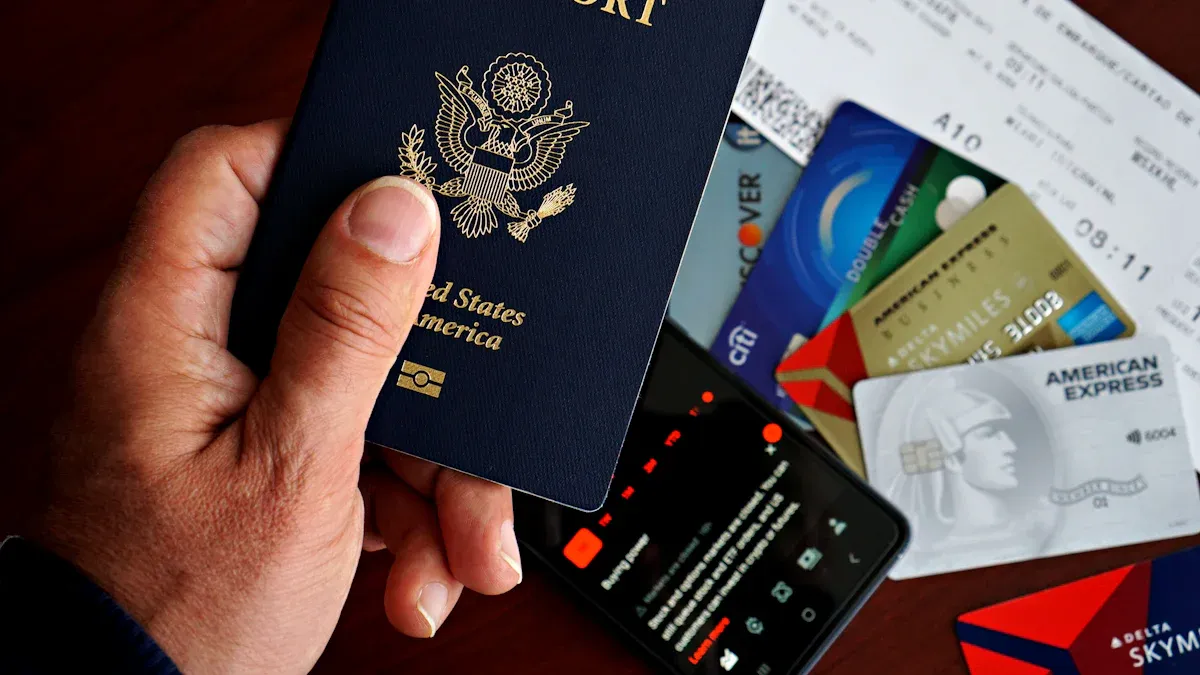
Image Source: pexels
For international students and new immigrants just arriving in the US, lacking an SSN (Social Security Number) is the first obstacle to applying for credit cards. But you do not need to stop there. Many banks and financial institutions provide dedicated paths, allowing you to start your credit journey without SSN.
Prepare ITIN: Effective Alternative to SSN
If you are not eligible for SSN, the Individual Taxpayer Identification Number (ITIN) is your most important alternative document. It is a tax processing number issued by the US Internal Revenue Service (IRS). With an ITIN, many banks open credit card applications to you.
Important Tip: ITIN’s main function is tax filing, but it is also widely accepted by financial institutions as identity for applying for credit cards and loans.
Applying for ITIN requires preparing some documents. You can submit the application along with your federal tax return.
- Core Forms: You need to fill out and sign
Form W-7(ITIN application) andForm 1040-NR(US nonresident alien income tax return). - Identity Proof: You need documents proving identity and foreign status. Passport is the best choice as it satisfies both. Other acceptable documents include visa, I-20, or DS-2019 forms.
- Submission: You can mail
Form W-7, tax return, and original or certified copies of identity documents to the designated IRS address or through IRS-authorized acceptance agents.
After obtaining ITIN, many mainstream banks accept it for credit card applications. You can directly enter your ITIN in the SSN field.
| Bank Name | Accepts ITIN Applications |
|---|---|
| Capital One | Yes |
| Chase | Yes |
| Citibank | Yes |
| American Express | Yes |
| Bank of America | Yes (recommended through branch) |
| Barclays | Yes (since 2024) |
| Wells Fargo | Yes |
Physical Cards Without SSN: Deserve EDU
Deserve EDU Mastercard is a credit card specifically for international students, a blessing for applicants without SSN. The biggest advantage of this card is that you can apply without SSN or any credit history.
Deserve uses its unique algorithm to evaluate applications. It does not focus on credit scores but comprehensively considers other factors, such as:
- The US university or college you attend
- Your major and degree
- Your passport and student visa information
- Your funds in a US bank account
As long as you are 18 years or older and enrolled in a US university, you can apply with your passport. This card not only has low thresholds but also effectively helps build credit history, an excellent starting point for your US credit life.
Leverage Mainland China Bank Background: ICBC USA and CMB Co-Branded Cards
If you are already a customer of certain banks in mainland China, this background can help you more easily obtain credit cards in the US. For example, ICBC USA and China Merchants Bank provide convenience for existing customers.
- ICBC USA: If you hold a China ICBC account, you can more easily apply for ICBC USA credit cards. They reference your financial status in mainland China, lowering US application thresholds.
- CMB Co-Branded Cards: China Merchants Bank has launched products cooperating with US issuers, allowing customers to use credit records in China to apply for US credit cards.
Suggestion: Before coming to the US, consult your mainland China bank to see if they offer similar cross-border financial services. This can be a shortcut to getting your first US credit card.
Apply for Virtual Credit Cards: Cheese and Jasper Platforms
In addition to traditional banks, some fintech companies provide innovative solutions. These platforms usually offer virtual or debit card services, very suitable for online spending.
- Cheese: As a financial platform friendly to new immigrants, Cheese provides debit card services without requiring SSN, helping manage daily expenses with cashback benefits. Though not a credit card itself, it can be a tool for initial USD fund management.
- Jasper (now CreditStacks): Jasper Cash Back Mastercard is designed for professionals with US work visas. You can apply without SSN or credit history but need to provide SSN within 60 days of card activation. This card offers high limits with no annual fee, a good transition choice for those planning long-term US work.
These fintech products are beneficial supplements to traditional bank cards and a practical US credit card recommendation. They help solve early online payment needs and gradually integrate into the US financial system.
After Obtaining SSN: Advanced US Credit Card Recommendations
Congratulations! After getting your Social Security Number (SSN), you open the door to applying for quality credit cards. Banks can now more easily check your credit report, meaning opportunities for higher cashback and better benefit mainstream cards. This step is core to building strong credit history. The following US credit card recommendation list introduces several best for beginners.
Mainstream Bank Entry Cards: Discover it Series
If you can only choose one card as your first “formal” credit card, the Discover it series is absolutely top choice. Discover is extremely friendly to credit beginners and international students with relatively low thresholds, the starting point for countless people building credit.
Discover offers multiple cards to suit different credit levels. Choose the most suitable based on your situation:
| Discover it Card Type | Minimum Credit Score Requirement |
|---|---|
| Discover it® Secured Credit Card | No minimum score, suitable for poor or no credit history |
| Discover it® Student Cash Back | Suitable for students with limited credit history (less than 3 years) |
| Discover it® Student Chrome | Suitable for students with limited credit history (less than 3 years) |
| Discover it® Cash Back | Recommended good credit (about 670+) |
| Discover it® Chrome | Recommended good credit (about 670+) |
Real Case Reference: Many users report success even with low scores. For example, users approved for Discover it Cash Back with 626 score. This shows Discover considers multiple factors beyond just score.
Main advantages of Discover it cards include:
- First-Year Cashback Match: At end of first year, Discover doubles all cashback earned. 5% cashback effectively becomes 10%.
- Quarterly Rotating High Cashback: 5% cashback on specific categories each quarter (like supermarkets, gas, Amazon).
- Newcomer Friendly: Relatively high approval probability even with short credit history.
Low-Threshold Cashback Card: Capital One Quicksilver
Capital One Quicksilver is another excellent entry-level card for beginners. Its threshold is not high, with simple and clear rewards structure, allowing easy cashback without thinking. The biggest highlight is unlimited 1.5% cashback on all purchases.
Here are the core features of this card:
| Feature | Details |
|---|---|
| Welcome Bonus | $200 cash rewards after spending $500 in first 3 months |
| Annual Fee | $0 |
| Introductory Purchase APR | 0% for first 15 months |
| Regular Purchase APR | 18.74% - 28.74% (variable) |
Additionally, this card has no foreign transaction fee, very suitable for international students and new immigrants needing to travel home or abroad.
Quick Tip: Though Quicksilver has low threshold, banks still evaluate income. Some students report denials with 750 score but low annual income (e.g., $9,000). Therefore, ensure your annual income information is accurate and sufficient to support spending.
Beginner-Friendly Card: Citi Double Cash
If you find remembering quarterly cashback categories troublesome, Citi Double Cash (Citi Double Cash Card) is your ideal choice. This card is famous for its simple and brutal cashback model, a regular on US credit card recommendation lists.
Its cashback mechanism is unique and efficient:
- When spending, you earn 1% cashback.
- When repaying, you earn another 1% cashback.
This means, as long as you repay on time in full, you stably earn total 2% cashback on all purchases, with no category limits or caps. For users wanting “one-card solution” simplicity, this is undoubtedly one of the best choices.
If Application Denied: Use Reconsideration
Excitedly submitted application but received denial letter? Don’t lose heart; this is very common in the US. Many banks have “reconsideration departments”; you can call to fight for another chance.
Preparation Before Calling:
- Wait for Denial Letter: It clearly states denial reasons, your communication basis.
- Check Credit Report: Verify if denial reasons match your credit report, check for errors.
- Prepare Reasons: Think why you want this card (e.g., its cashback structure suits your spending), prepare to explain or refute denial reasons.
What to Say on Call: You can start with something like:
“Hello, my name is [your full name]. I recently applied for [credit card name] on [application date] but received a denial notice. I would like to understand the specific denial reasons and hope you can reconsider my application.”
Handling Common Denial Reasons: If reason is “You already have too high credit limit,” proactively offer solutions. For example: “I understand. Since I already have [existing card name] with $15,000 limit at your bank, can you transfer $5,000 limit to this new card? This way the bank doesn’t issue new credit, and I can start using the new card.”
Stay polite, honest, and flexible to greatly increase reconsideration success chances.
Application Required Materials and Practical Tips
Preparing application materials is the first step to successful approval. Banks need these documents to verify identity and repayment ability. Below are core materials and practical tips.
Core Identity Documents: SSN or ITIN
Your identity documents are the foundation of application. Banks need SSN or ITIN to verify identity and pull credit reports.
Quick Tip: Even without SSN, having ITIN allows applying for most mainstream bank credit cards.
Applying for SSN or ITIN requires identity proof documents. All must be originals or certified copies.
- Applying for SSN: Adults usually need US driver’s license, state ID, or US passport.
- Applying for ITIN: Passport is best choice, as it proves both identity and foreign status. Without passport, provide at least two other documents, such as:
- Visa
- US driver’s license or state ID
- National ID (must include photo, name, address, birthdate, expiration)
- Birth certificate (for dependents under 18)
Essential Contact Information: US Phone Number and Address
Banks need to contact you via phone or SMS and mail physical cards. Provide valid US contact information.
- US Phone Number: For receiving verification codes and bank notifications. If no physical SIM yet, consider Google Voice for a free US number.
- US Address: Need a stable address for receiving mail. This will be your billing address; banks mail credit cards and important letters here. Ensure not a P.O. Box but a real residential address.
Income Filling Tips
You may worry about no “formal” income as a student. Actually, banks’ income definition is broader than imagined. By US law, any funds you reasonably expect to receive can count as annual income.
You can legally include income sources like:
- Scholarships and Grants: Portion remaining after tuition for your free use.
- Family Support: Regular living expenses from parents or relatives.
- Part-Time or Internship Income: Including on-campus work or CPT/OPT internship wages.
- Freelance Income: Such as tutoring, delivery, or online work income.
Important: Be honest; do not overstate. Banks may require proof, like bank statements or scholarship details in admission letter.
Application Channels: Online, Phone, and Pre-Approval
Choosing the right channel improves success rate.
- Online Application: Fastest and most common. Just fill form on bank website.
- Phone Application: If issues with online form, call customer service to complete over phone.
- Pre-Approval: Strongly recommended for beginners! Many banks offer pre-approval tools with “soft inquiry” not affecting score. Pre-approval shows likely approvable cards, excellent for finding suitable US credit card recommendations.
Some banks provide online pre-approval tools; check directly on their sites:
| Bank Name | Pre-Approval Tool URL |
|---|---|
| FNBO | https://www.fnbo.com/personal-banking/credit-cards/ |
From Cardholding to High Score: Proper Use and Credit Maintenance

Image Source: pexels
Getting a credit card is just the first step; properly using it to build your score from zero to high is the real challenge. Good card habits are the cornerstone of establishing financial credibility in the US.
Understanding Credit Score Composition
Your credit score is not a mysterious number. It consists of several key parts, with FICO score the most used model. Understanding these helps targeted maintenance.
| Component | Weight |
|---|---|
| Payment History | 35% |
| Amounts Owed | 30% |
| Length of Credit History | 15% |
| New Credit | 10% |
| Credit Mix | 10% |
Keep Low Utilization Rate
Utilization rate is used amount vs. total credit limit ratio. This is the second largest factor affecting score.
Expert Advice: Always keep credit utilization below 30%. For example, if total limit $10,000, bill balance best not exceed $3,000. People with excellent scores usually keep utilization in single digits.
Pay On Time in Full
Payment history is the most important part of your score, accounting for 35%. One late payment can damage score and stay on report up to seven years.
Remember, late payments have serious consequences:
- Charged $25 to $35 late fees.
- Rate may reset to up to 29.99% penalty APR.
- Credit score drops.
Set up autopay to avoid forgetting payments.
Maintain Credit History Length
Credit history length accounts for 15% of FICO score. Banks tend to view long-term responsible credit management as reliable. Your first credit card, even with low limit, do not easily close. Closing old accounts shortens average account age, potentially negatively impacting score.
Now you master the core three steps to building credit: choose suitable “icebreaker card,” prepare materials and apply, responsibly use and repay. Be patient; building credit is long-term. Good credit brings real rewards: easier apartment rentals, lower rates on auto/home loans, saving significant interest. Start from applying your first credit card, take the first step to good financial credibility in the US. Wish you smooth applications and soon become a high-score achiever!
FAQ
Can I apply for a credit card without SSN or ITIN?
You can first try secured cards at banks with existing deposit accounts, like Bank of America. Some banks allow in-branch applications with passport. For students, Deserve EDU card is an excellent choice without SSN or ITIN.
As a student with no income, how to fill the application form?
You can legally include funds expected for repayment in total income. This includes scholarships/grants remaining after tuition, family-provided living expenses, and part-time/internship wages.
Important Tip: Be honest with income information. Banks may require related proofs.
Can I apply for multiple credit cards at once?
Not recommended. Each application leaves a “hard inquiry” on your credit report, lowering score short-term. Better focus on one card first, successfully build good records for about 6 months.
Does checking my own credit score affect it?
No. Self-checks are “soft inquiries,” no impact on score. Feel free to use bank apps or free tools like Credit Karma to regularly check progress.
*This article is provided for general information purposes and does not constitute legal, tax or other professional advice from BiyaPay or its subsidiaries and its affiliates, and it is not intended as a substitute for obtaining advice from a financial advisor or any other professional.
We make no representations, warranties or warranties, express or implied, as to the accuracy, completeness or timeliness of the contents of this publication.
Related Blogs of

2025 U.S. Job Search Websites Comparison: In-Depth Analysis of 20 Platforms' Pros and Cons

What Is Zelle? 2025 Latest Zelle Transfer Guide: Registration, Usage, and Security Full Strategy

Exclusive for Chinese Users: Longbridge Securities Account Opening Process and Permanent Commission-Free Strategy

Wise Account Registration and Activation Guide: Easily Handle Cross-Border Collections and Remittances

Choose Country or Region to Read Local Blog
 Australia
 Austria
 Belgium
 Canada
 Cyprus
 Czech Republic
 Denmark
 Estonia
 Finland
 France
 Germany
 Greece
 Hong Kong
 India
India Indonesia
 Ireland
 Italy
Italy Japan
Japan Latvia
 Lithuania
 Luxembourg
 Malaysia
 Malta
Malta Morocco
 Nepal
Nepal Netherlands
 New Zealand
 Norway
 Pakistan
 Philippines
 Poland
 Portugal
 Romania
 Singapore
 Slovakia
 Slovenia
 South Africa
 South Korea
 Spain
Spain Sweden
 Thailand
 The United States
 Turkey
 United Arab Emirates
 United Kingdom
 Vietnam
Contact Us




BIYA GLOBAL LLC is a licensed entity registered with the U.S. Securities and Exchange Commission (SEC No.: 802-127417); a certified member of the Financial Industry Regulatory Authority (FINRA) (Central Registration Depository CRD No.: 325027); regulated by the Financial Industry Regulatory Authority (FINRA) and the U.S. Securities and Exchange Commission (SEC).
BIYA GLOBAL LLC is registered with the Financial Crimes Enforcement Network (FinCEN), an agency under the U.S. Department of the Treasury, as a Money Services Business (MSB), with registration number 31000218637349, and regulated by the Financial Crimes Enforcement Network (FinCEN).
BIYA GLOBAL LIMITED is a registered Financial Service Provider (FSP) in New Zealand, with registration number FSP1007221, and is also a registered member of the Financial Services Complaints Limited (FSCL), an independent dispute resolution scheme in New Zealand.