Where Is the Best Place to Exchange RMB for USD? Comprehensive Analysis of Banks vs. Online Platforms Pros and Cons



Image Source: unsplash
Are you thinking about the best channel for exchanging RMB to USD? The answer to this question is not absolute. You need to make a choice based on your own situation.
- Large Amount Exchanges and Ultimate Security: Banks are your reliable choice.
- Small Amount High-Frequency and Cost-Effectiveness: Compliant online platforms are usually more cost-effective.
Choosing the “most cost-effective” solution lies in clarifying your core needs. Different amounts, frequencies, and requirements for security determine the path that suits you best.
Key Takeaways
- When choosing a channel for exchanging RMB to USD, you need to consider your specific needs. For large amount exchanges and pursuing security, banks are the top choice. For small amount high-frequency exchanges, online platforms are more convenient.
- Bank exchanges are safe and reliable, suitable for large transactions. They have an annual 50,000 USD limit, but providing proof materials can break through it. The disadvantages of banks are high exchange rate costs and complicated processes.
- Online platform exchanges have favorable rates and simple operations. They are suitable for small amount high-frequency exchange needs. When choosing online platforms, be sure to confirm if the platform is compliant.
- Money changers are suitable in regions like Hong Kong for small amount cash exchange. They are not suitable for large amount remittances. You need to confirm if the money changer holds a legitimate license.
- Banks, online platforms, and money changers each have pros and cons. Banks provide the highest security assurance. Online platforms provide the best efficiency and cost. Money changers provide instant cash exchange.
Bank Exchange: Traditional and Reliable
Image Source: unsplash
When handling large sums of money, banks are undoubtedly the most reassuring choice. Their reputation and strict regulatory system provide fund security assurance unmatched by other channels.
Core Advantages: High Security and Large Amount Handling
The biggest advantage of banks is their impeccable security. Every transaction you make is tightly protected by the national financial system, giving users needing to transfer large amounts great peace of mind. Banks also have the capability to handle large amount exchanges.
In mainland China, personal foreign exchange has clear quota regulations:
- Each person has an annual convenience quota equivalent to 50,000 USD.
- If your exchange needs (such as paying tuition) exceed this quota, you can provide the bank with authenticity materials like admission notices, expense proofs to complete the exchange, with no upper limit.
This provides a compliant and reliable official path for large payment scenarios like studying abroad or overseas medical treatment.
Main Disadvantages: High Exchange Rate Costs and Complicated Processes
Bank reliability comes with corresponding costs. The exchange rates provided by banks usually include higher spreads, meaning you get fewer USD for the same RMB compared to other channels.
Additionally, bank processes are relatively complicated and time-consuming. You usually need to visit a branch in person, queue, and fill out multiple forms. If the exchange amount exceeds the annual total, you must prepare and submit a series of proof documents. For example, for overseas study expenses, you need to provide passport, valid visa, and overseas school expense proof and other materials. This process requires advance planning and extra time and effort.
Applicable Scenarios
Overall, banks are most suitable for the following needs:
- Large Amount Exchanges: For example, one-time payment of hundreds of thousands RMB equivalent tuition or medical fees.
- Pursuing Highest Fund Security: Security requirements higher than exchange rate costs and convenience.
- Needing to Withdraw USD Cash: Banks are the most direct and compliant channel for obtaining foreign currency cash.
If your needs match the above, choosing a bank will be a steady decision.
RMB to USD: Convenient Choice of Online Platforms
If you find bank processes too complicated, online exchange platforms provide a modern solution for you. For small amount, high-frequency RMB to USD needs, they are often more efficient and economical choices.
Core Advantages: Favorable Rates and Convenient Operations
The biggest attraction of online platforms is their better rates and extremely low overall costs. Many well-known compliant platforms (such as Biyapay) use “market mid-rate” for quotes. This means they do not set large buy-sell spreads like banks, allowing you to lose less money in transactions.
What is Market Mid-Rate? This is the average of financial market buy and sell rates, considered the “fairest” rate. Platforms using this rate usually only charge a transparent, fixed service fee.
Operational convenience is another major advantage. You no longer need to visit physical branches; just through mobile app or website, complete all operations in minutes. Funds can be directly remitted to your designated overseas bank account, with the entire process clearly visible, saving time and effort.
Main Disadvantages: Platform Selection Needs Caution
The convenience of online platforms also comes with risks, so you must cautiously choose compliant platforms. There are some illegal platforms on the market that may threaten your fund security. When choosing, you need to watch for the following danger signals:
- Promising Unrealistic Returns: Claiming “no risk” or offering rates far above market levels.
- Lack of Regulatory Information: Unable to provide registration information with relevant financial regulatory authorities (such as Hong Kong Customs MSO license).
- Weak Security Measures: Website or app looks unprofessional, without standard security features like two-factor authentication.
- Requiring Additional Funds for Withdrawal: This is a typical fraud tactic.
Choosing platforms like Biyapay with clear regulatory qualifications and good user reputation is the first step to ensure your fund security.
Applicable Scenarios
Online platforms are very suitable for handling daily cross-border fund needs. If you have the following scenarios, prioritize considering them:
- Small Amount High-Frequency RMB to USD: For example, paying overseas subscription services, transferring living expenses to family, or receiving small salaries.
- Pursuing Cost-Effectiveness: Hoping to get the best rate each time to maximize fund value.
- Needing Fast Arrival: Compared to banks taking days or longer, many online platforms can achieve same-day or next-day arrival, far more efficient.
Note that although operations are convenient, you still need to comply with mainland China’s personal annual equivalent 50,000 USD exchange quota regulation. Platforms themselves may also set single transaction limits based on your verification status.
Money Changers: Supplementary Option in Specific Regions
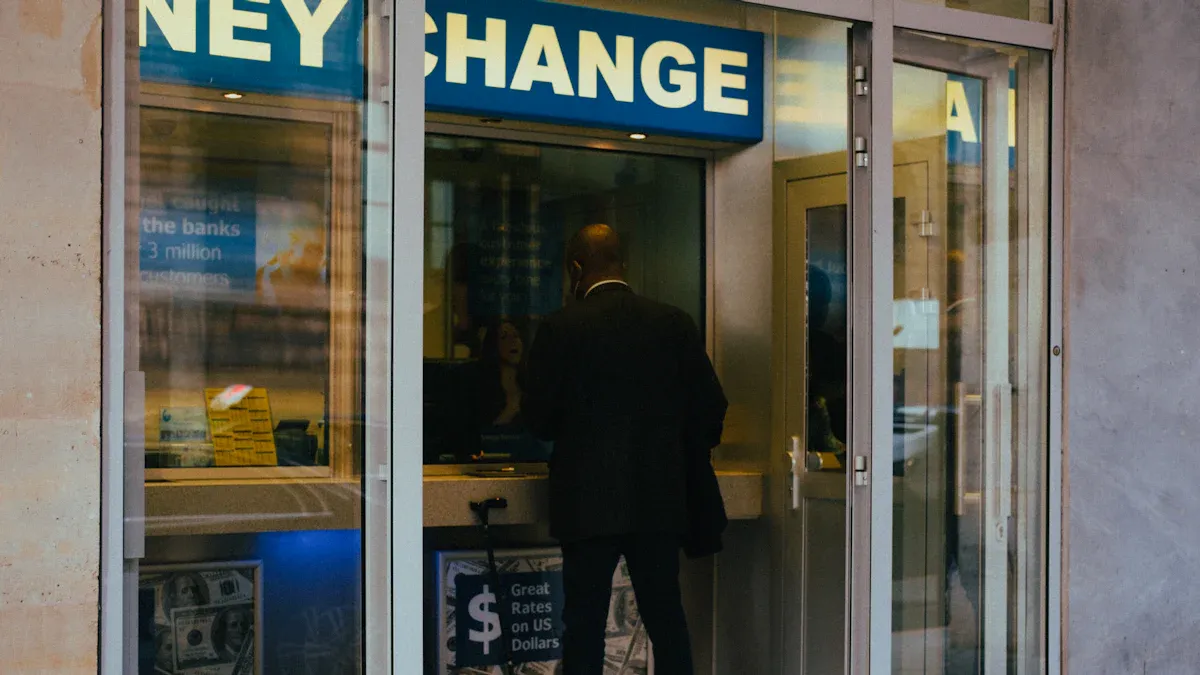
Image Source: pexels
Besides banks and online platforms, you may have heard of “money changers.” You need to be clear that this method mainly exists in regions with high financial freedom like Hong Kong and is not applicable for direct operation in mainland China. If you are in Hong Kong and have small amount cash exchange needs, money changers can be a useful supplementary option.
Advantages and Disadvantages
The most attractive aspect of money changers is their rate advantage, especially for small amount cash exchanges. Due to lower operating costs, their rates are usually more competitive than banks in Hong Kong.
Tip: In Hong Kong, licensed money changers’ spreads (buy-sell difference) are usually lower than banks, meaning you can exchange more cash.
| Exchange Channel | USD Cash Exchange Spread (Reference) |
|---|---|
| Hong Kong Region Banks | About 2.27% |
| Licensed Money Changers | About 1.29% |
However, behind convenience you need discernment ability. Your primary task is to confirm its legitimacy. Legitimate money changers must hold a Money Service Operator (MSO) license issued by Hong Kong Customs and comply with strict regulatory requirements. At the same time, you also need to note transaction limits. For example, when single transaction amounts reach or exceed 8,000 HKD, the store must register your identity information.
Applicable Scenarios
Overall, money changers are not a mainstream cross-border remittance tool but a convenient choice in specific scenarios.
If you are already in Hong Kong and need to solve temporary, small-amount cash issues, money changers are prepared for you.
They are very suitable for the following situations:
- Short-Term Travel: When traveling in Hong Kong, needing to exchange small amounts of RMB cash for USD or HKD for daily consumption.
- Small Amount Shopping: Needing small foreign currency cash for payments, with small amounts.
- Emergency Exchange: During non-bank hours, having urgent cash exchange needs.
In summary, do not use money changers as the main channel for large fund transfers. They are more like a convenient supplement for meeting instant small-amount cash needs after arriving in specific regions.
Three Channels Side-by-Side Comparison: How to Choose?
After understanding the features of banks, online platforms, and money changers, you may still ask: “Which one should I choose?” The side-by-side comparison below will help you make the wisest decision from four dimensions: cost, efficiency, security, and specific scenarios.
Cost Comparison: Rates and Fees
Cost is one of the factors you care most about when exchanging. It mainly consists of two parts: rate spread and various fees.
Banks: Complex Fee Structure with Hidden Costs Bank quotes usually include higher spreads as profit. In addition, you may need to pay multiple fees. A complexity in international wire transfers is hidden fees. Some banks may charge intermediary bank fees, usually not clearly listed in initial quotes, generally between 15 USD to 30 USD.
Below is an example of some banks’ international remittance fee structures; you can intuitively feel their complexity:
| Bank Name | Fee (%) | Fee (Min/Max) | Telegraph Fee (USD) | Intermediary Bank Fee/Full Amount Arrival Service Fee (USD) |
|---|---|---|---|---|
| Bank of China | 0.1 | 50/200 | 20 | Usually borne by recipient |
| ICBC | 0.1 | 30/150 | 15 | 25 (Full Amount Arrival Service Fee) |
| China Merchants Bank | 0.12 | 20/100 | 18 | Usually not charged, recommend confirming with recipient |
| CIB | 0.1 | 30/200 | 20 | Usually borne by recipient |
- Online Platforms: Transparent Costs, Better Rates Unlike banks, compliant online platforms usually use near-market rates, only charging a clear, fixed service fee. They usually do not charge telegraph fees and intermediary bank fees, significantly lowering your overall costs.
- Money Changers: Advantage in Small Amount Cash Money changers have good rates for small amount cash exchanges but are not applicable for large remittances, so not included in comprehensive cost comparison.
Efficiency Comparison: Operational Convenience and Arrival Speed
Time is money; exchange efficiency is equally important.
- Banks: Time-Consuming Process, Limited by Business Hours You need to visit branches in person, queue for service, and fill out paper forms. The entire process may take half a day or longer. Bank business hours also limit your operational freedom.
- Online Platforms: 24/7 Service, Quick Operations Online platforms provide 24/7 all-day service. This means you can complete all operations anytime, anywhere via mobile phone. You are no longer limited by bank business hours, even on weekends or holidays you can initiate transactions. Many platforms can achieve same-day or next-day arrival, far more efficient than traditional banks.
- Money Changers: Instant Exchange, Immediate Receipt For small amount cash, money changers have the highest efficiency. You can complete transactions on the spot and immediately get needed foreign currency, very suitable for emergency scenarios.
Security Comparison: Fund Assurance and Compliance
Fund security is the bottom line for exchanging. Different channels have different assurance mechanisms.
- Banks: National-Level Security Assurance Bank security is the highest level. Your deposits in banks are protected by the national deposit insurance system. Since 2015, mainland China has implemented deposit insurance, providing up to 500,000 RMB compensation for your accounts (including RMB and foreign currency deposits). This provides you with a solid fund safety net.
- Online Platforms: Compliance is Key You may worry about online platform security. In fact, compliant online platforms have very high security. They must comply with strict financial regulatory requirements, implementing a set of standards called KYC (Know Your Customer) and AML (Anti-Money Laundering) processes.
This set of processes includes:
- Identity Verification: Collecting and verifying your ID documents, address proof, etc.
- Transaction Monitoring: Real-time monitoring of fund flows, detecting abnormal transaction patterns.
- List Screening: Comparing user information with global sanctions and watch lists.
Conversely, choosing non-compliant platforms exposes your funds to huge risks. For example, platforms like
bcexus.comandTofroc.comare criticized for lacking regulatory authorization and user-reported withdrawal difficulties. Therefore, choosing platforms with formal licenses and good reputation is crucial. - Money Changers: Need Self-Verification In regions like Hong Kong, you need to personally confirm if the money changer holds a valid license issued by local regulatory authorities (such as Hong Kong Customs) to ensure transaction legitimacy.
Scenario Comparison: Cash Withdrawal and Remittance Amount
Finally, we match the most suitable channel based on your specific needs.
- If You Need to Withdraw USD Cash
- Banks are your only compliant choice in mainland China for obtaining foreign currency cash.
- Money Changers are supplementary options for solving small emergency cash needs in overseas regions like Hong Kong.
- Online Platforms mainly for online remittances, usually do not provide cash services.
- If Your Remittance Amounts Differ
- Large Amount Remittances (ExceedingEquivalent 50,000 USD): You must choose banks. According to regulations, purchases exceeding annual convenience quota require providing authenticity proof materials to the bank, such as paying overseas tuition or medical expenses. Banks are the designated official channel for handling such large compliant needs.
- Small to Medium Amount Remittances (Within Equivalent 50,000 USD Quota): For daily RMB to USD needs, online platforms are the best in cost-effectiveness and convenience. Whether paying bills, transferring living expenses to family, or small shopping, they save you time and money.
Through the above four dimensions comparison, I believe you can clearly judge which channel suits you best.
There is no absolute “most cost-effective” for RMB to USD exchange, only the “most suitable” for you. You can make clear decisions based on your needs.
- Banks: Top choice for large amounts, cash withdrawal, or pursuing ultimate security.
- Compliant Online Platforms: Preferred for cost-effectiveness and convenience in small remittances, more aligned with modern user habits.
- Money Changers: Supplement for meeting small emergency cash needs in specific regions like Hong Kong.
Action Suggestion: Before exchanging, spend a few minutes comparing bank rates and online platforms’ real-time quotes, make wise choices.
FAQ
Is There a Quota Limit for Personal Foreign Exchange?
Yes, personal foreign exchange in mainland China must comply with quota regulations.
You have an annual convenience quota equivalent to 50,000 USD. If your needs exceed this quota, such as paying tuition, you can provide authenticity proof materials to the bank to complete the exchange, with no upper limit.
Are Online Platform Exchanges Really Safe?
Your fund security completely depends on platform compliance. You must choose platforms holding formal financial licenses, such as Hong Kong Customs MSO license. These platforms comply with strict regulatory requirements and can effectively protect your funds. Please stay away from platforms unable to provide regulatory information.
Why Are Bank Rates Worse Than Online Platforms?
This mainly comes from “rate spread.” Bank quotes usually include higher spreads as profit. Many online platforms use near-market mid-rates with minimal spreads, only charging a transparent service fee, thus lower overall costs for you.
Can I Withdraw USD Cash Through Online Platforms?
Usually no. Online platforms’ core function is transferring funds from one account to another.
- Needing to Withdraw USD Cash: Banks are your only compliant choice.
- Online Platforms: Mainly for cashless online remittances.
*This article is provided for general information purposes and does not constitute legal, tax or other professional advice from BiyaPay or its subsidiaries and its affiliates, and it is not intended as a substitute for obtaining advice from a financial advisor or any other professional.
We make no representations, warranties or warranties, express or implied, as to the accuracy, completeness or timeliness of the contents of this publication.
Related Blogs of
Avoid These Pitfalls: Tips for Successfully Registering and Using a U.S. PayPal Account


Beginner's Guide to US Individual Income Tax Rates: Understanding Minimum Filing Income Requirements

How Mainland Chinese Can Apply for a Hong Kong Bank Card: In-Depth Analysis of HSBC and BOC Hong Kong Account Opening Requirements

Wise Account Registration and Activation Guide: Easily Handle Cross-Border Collections and Remittances

Choose Country or Region to Read Local Blog
 Australia
 Austria
 Belgium
 Canada
 Cyprus
 Czech Republic
 Denmark
 Estonia
 Finland
 France
 Germany
 Greece
 Hong Kong
 India
India Indonesia
 Ireland
 Italy
Italy Japan
Japan Latvia
 Lithuania
 Luxembourg
 Malaysia
 Malta
Malta Morocco
 Nepal
Nepal Netherlands
 New Zealand
 Norway
 Pakistan
 Philippines
 Poland
 Portugal
 Romania
 Singapore
 Slovakia
 Slovenia
 South Africa
 South Korea
 Spain
Spain Sweden
 Thailand
 The United States
 Turkey
 United Arab Emirates
 United Kingdom
 Vietnam
Contact Us




BIYA GLOBAL LLC is a licensed entity registered with the U.S. Securities and Exchange Commission (SEC No.: 802-127417); a certified member of the Financial Industry Regulatory Authority (FINRA) (Central Registration Depository CRD No.: 325027); regulated by the Financial Industry Regulatory Authority (FINRA) and the U.S. Securities and Exchange Commission (SEC).
BIYA GLOBAL LLC is registered with the Financial Crimes Enforcement Network (FinCEN), an agency under the U.S. Department of the Treasury, as a Money Services Business (MSB), with registration number 31000218637349, and regulated by the Financial Crimes Enforcement Network (FinCEN).
BIYA GLOBAL LIMITED is a registered Financial Service Provider (FSP) in New Zealand, with registration number FSP1007221, and is also a registered member of the Financial Services Complaints Limited (FSCL), an independent dispute resolution scheme in New Zealand.