Must-Read for Beginners: 2026 Taiwan Stock AI Concept Stocks Entry-Level Lazy Package



Image Source: pexels
Want to ride the AI investment express but don’t know where to start? Global AI total spending is expected to grow from $988 billion in 2024 to $2 trillion in 2026, showing enormous market potential.
💡 If pure AI companies are scientists designing the brain, then AI concept stocks are the experts manufacturing the body, providing energy, and building the activity space for this brain.
To help beginners get started quickly, the table below clearly compares the core differences between AI concept stocks, pure AI stocks, and AI ETFs.
| Category | Definition | Investment Threshold | Risk and Return |
|---|---|---|---|
| AI Concept Stocks | Companies whose core business benefits from AI development. In Taiwan stocks, mostly hardware manufacturers. | Lower | Moderate risk and return |
| Pure AI Stocks | Companies whose core business is developing AI technology or software, such as algorithm companies. | Higher | High risk and high return |
| AI ETFs | Basket funds combining multiple AI-related stocks for diversified investment. | Lowest | Diversified risk, relatively stable returns |
Key Points
- Taiwan plays an important role in AI hardware manufacturing, with its industry chain divided into upstream, midstream, and downstream.
- AI concept stocks are companies that benefit from AI development, mostly hardware manufacturers, with moderate investment risk and return.
- There are three strategies for investing in AI: conservative types can choose AI-themed ETFs, steady types can invest in industry leaders, and aggressive types can dig into niche potential stocks.
- AI is a long-term trend; investors should focus on long-term value and choose appropriate investment methods based on their risk tolerance.
- Before investing, conduct thorough research, understand company operations and market risks, and do not blindly follow trends.
Full Overview of Taiwan’s AI Industry Chain
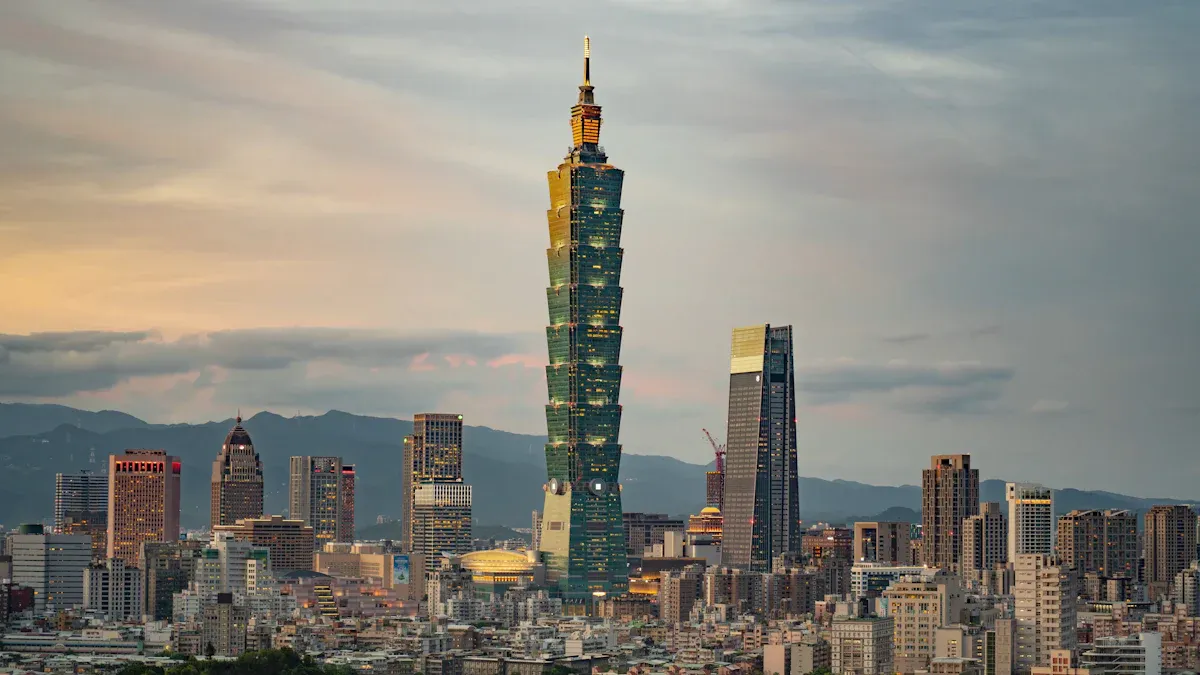
Image Source: pexels
To invest in AI concept stocks, you first need to understand Taiwan’s key position in the global AI hardware supply chain. Taiwan’s AI industry chain is complete and can be clearly divided into upstream, midstream, and downstream parts, each with representative leading enterprises.
💡 Simply put, upstream is responsible for designing and manufacturing the AI “brain” and “nerves,” midstream assembles them into powerful “bodies,” and downstream enables these “bodies” to function in various industries.
Upstream: Chip Design and Key Components
Upstream is the foundation of the entire AI industry, mainly handling the highest technical content parts.
Taiwan’s semiconductor manufacturing holds an absolute leading position globally. TSMC produces over half of the world’s advanced semiconductors, with its share in the contract chip manufacturing market increasing to 64%. Tech giants like Apple, NVIDIA, and AMD rely on TSMC’s advanced processes. In addition to wafer foundry, Taiwanese manufacturers also provide key technical support for NVIDIA and others’ AI GPUs, including:
- Advanced packaging technology (such as advanced packaging)
- High-bandwidth memory (HBM) integration
- Cooling and power optimization
Midstream: Server OEM and Module Manufacturing
Midstream manufacturers are responsible for assembling upstream chips and components into core equipment like AI servers. AI servers are the infrastructure for training and running large language models, with demand growing explosively.
According to IDC predictions, the AI server market will see high-speed growth.
In this field, Taiwanese manufacturers also play a dominant role.
- Foxconn holds nearly 40% of the global AI server market share.
- Quanta Computer is the world’s second-largest server assembler, with AI servers expected to account for 70% of its total server revenue.
- Wistron has also secured large AI server orders from NVIDIA and AMD.
These companies provide AI servers for cloud service giants like Microsoft, Amazon, and Google, serving as key links for realizing AI computing power.
Downstream: Terminal Applications and Solutions
Downstream is the link that lands AI technology into specific application scenarios. Taiwanese enterprises are actively integrating AI into smart manufacturing, Internet of Things (IoT), and smart cities.
In smart manufacturing, enterprises achieve production automation and real-time monitoring by integrating AI image recognition and robotic arm control smart modules, significantly improving production efficiency. In smart city construction, cities like Taipei and Tainan are testing AI-driven smart traffic systems and air quality monitoring, relying on IoT devices and AI algorithms to make urban management more efficient.
Selected List of Taiwan Stock AI Concept Stocks

Image Source: unsplash
After understanding the industry chain structure, the next step is to identify key enterprises in each link. This list gathers representative companies in Taiwan’s AI supply chain; they are the core pillars building the AI hardware empire. For beginners wanting to invest in Taiwan stock AI field, starting research from these leading enterprises is an excellent starting point for building a portfolio.
💡 The following list includes company names, stock codes, and their core businesses in the AI industry chain, helping you quickly locate areas of interest.
AI Chip Design (ASIC & IP)
AI chips are the “brain” driving artificial intelligence computing. Application-Specific Integrated Circuits (ASICs) are high-efficiency chips customized for specific AI tasks, while Silicon Intellectual Property (IP) are reusable chip design blueprints. This field has extremely high technical barriers and is at the top of the value chain.
- TSMC (2330): Global wafer foundry leader, producing the most advanced AI chips for NVIDIA, AMD, and other giants.
- Alchip (3661): Leading ASIC design service provider, offering customized AI chips for cloud service providers.
- Global Unichip (3443): TSMC-invested ASIC design company, focusing on high-speed computing IP and design services.
- MediaTek (2454): Global leading mobile chip designer, actively expanding into edge AI and automotive AI chips.
According to market forecasts, these top design companies have very promising growth prospects:
- Alchip: Strong demand for AI ASICs is expected to drive company revenue to achieve 40%–50% annual compound growth from 2025 to 2027. By 2026, growth will mainly be driven by Amazon’s 3nm AI chip projects.
- Global Unichip: Although facing short-term challenges in 2024, it is expected to recover growth in 2025 from multiple 3- to 5-nanometer projects. New AI projects with Google and Meta are expected to drive double-digit revenue growth in 2026.
Cooling Solutions
The stronger the computing power of AI servers, the more astonishing the heat generated. Traditional air cooling is gradually unable to meet high-density computing needs, making liquid cooling the new market favorite.
💡 Simply put, air cooling uses fans to blow, while liquid cooling directly removes heat with water pipes; the latter’s efficiency is far higher than the former.
Liquid cooling not only has higher cooling efficiency but also optimizes data center space utilization and saves massive energy. The table below compares the main differences between the two technologies:
| Feature | Air Cooling | Liquid Cooling |
|---|---|---|
| Upfront Cost | Lower | Higher |
| Operating Cost | Higher | Lower |
| Energy Efficiency | Lower | Higher |
| Support for High-Density Racks | Lower | Higher |
| Carbon Footprint | Higher | Lower |
In the cooling field, the following Taiwan stock companies play key roles:
- Chaun-Choung (3017): Leader in server cooling solutions, simultaneously developing air and liquid cooling technologies.
- Taisol (3324): Global major cooling module supplier, actively developing liquid cooling products like cold plates.
Power Supply and Power Management
AI chips are “power hogs.” Take NVIDIA’s latest B200 GPU for example, its power consumption has significantly increased compared to the previous generation, posing strict challenges to the entire server cabinet power system.
| Feature | NVIDIA H200 | NVIDIA B200 |
|---|---|---|
| Max TDP | 700 W | 1000 W |
| Recommended Power Supply | 1100 W | 1400 W |
A server cabinet fully loaded with B200 GPUs may have total power consumption up to 120 kW, equivalent to the electricity usage of dozens of households. This brings huge opportunities for high-efficiency, high-power supply providers. AI server power supplies also have much higher profits than traditional servers, with enormous growth potential.
- Delta Electronics (2308): Global leader in power management and cooling solutions, with AI-related business revenue growing rapidly.
- Lite-On Technology (2301): Major power supply manufacturer, actively expanding AI server-related power system capacity.
Delta Electronics’ AI-related business revenue is expected to grow from this year’s NT$115.1 billion to NT$367.8 billion in 2027, showing strong growth momentum.
PCBs and High-Speed Transmission Substrates
If chips are the brain, then Printed Circuit Boards (PCBs) and ABF (Ajinomoto Build-up Film) substrates are the “neural network” connecting various brain regions. AI servers need to transmit massive data, requiring extremely high layers, materials, and processes for circuit boards.
AI server motherboards generally adopt a hybrid architecture combining 20-30 layer traditional multi-layer boards and multi-layer HDI boards, driving explosive demand for high-end PCBs. At the same time, the market size for ABF substrates used in advanced chip packaging is expected to grow from about $12 billion to over $18 billion in the next five years.
- ITEQ (2383): Global leading halogen-free copper-clad laminate supplier, key vendor for AI server high-frequency high-speed materials.
- Gold Circuit Electronics (2368): Major server PCB supplier, benefiting from AI server demand for high-layer boards.
- Unimicron (3037): Global ABF substrate leader, providing key packaging substrates for AI and high-performance computing chips.
Machine Vision and AI Sensing
Machine vision gives machines “eyes” and is key technology for achieving industrial automation and smart manufacturing. By combining AI deep learning, machine vision systems can handle complex detection tasks, significantly improving production efficiency and product quality.
In Taiwan, AI machine vision is widely applied in PCB inspection, product defect screening, and automation equipment guidance. For example, some precision machinery companies use AI thermal compensation technology to improve mold processing accuracy by 60%.
- Solomon (2359): Leading 3D vision and industrial AI solution provider, with AI vision software guiding robotic arms for complex tasks.
- Quanta (2382): In addition to being a server OEM giant, Quanta also actively applies AI vision technology to automation production lines in its smart factories.
Three Taiwan Stock AI Investment Strategies
After understanding the key companies in the industry chain, investors can choose different investment strategies based on their risk tolerance. The following introduces three Taiwan stock AI investment methods from conservative to aggressive, helping beginners find the most suitable path.
💡 There is no absolute good or bad in investing; the key is finding a strategy that matches your risk preference and investment goals.
Conservative: Invest in AI-Themed ETFs
For investors hoping to diversify risks and not wanting to research individual companies, investing in AI-themed ETFs is an ideal starting point. ETFs are like a basket containing multiple AI-related company stocks, effectively avoiding risks from sharp fluctuations in a single company’s stock price.
However, investors need to note concentration risks in the Taiwan market. Take Yuanta Taiwan 50 (0050) for example, TSMC accounts for about 50% of its components.
| ETF Name | TSMC (2330) Weight |
|---|---|
| 0050 Yuanta Taiwan 50 | About 50% |
| 006208 Fubon Taiwan 50 | About 50% |
This means that although ETFs achieve diversification, overall performance is still highly correlated with a few large tech companies.
Steady: Allocate to Industry Leaders
The steady strategy focuses on investing in leading enterprises that dominate the AI industry chain. These companies usually have strong technical barriers, stable customer relationships, and healthy finances. For example, Hon Hai Precision holds 40% of the global AI server market share, with order visibility extending to 2027, showing strong growth potential.
Investors can focus on companies like TSMC (2330) and Hon Hai (2317), and refer to financial indicators like P/E ratio for evaluation. Through digital asset platforms like Biyapay, investors can conveniently trade these leading companies’ stocks. However, investing in leaders also requires vigilance against risks, such as geopolitical tensions, and low-price competition from mainland China in chip manufacturing, which may pose challenges to these Taiwan stock giants.
Aggressive: Dig into Niche Potential Stocks
The aggressive strategy suits investors with higher risk tolerance who are willing to invest time in in-depth research. This strategy aims to find smaller companies with high growth potential in specific niches. These companies may achieve explosive growth in the future due to an innovative technology or unique market positioning.
However, high return potential often comes with high risk. Financial theory and data show that small companies have much higher risks than large ones. The highest-risk companies may have median annualized returns as low as -28.9%. These companies have limited resources and less diversified business models, making them more vulnerable to market impacts. Therefore, investors choosing this strategy must conduct thorough research and prepare for possible sharp price fluctuations.
Investing in AI is not limited to one way. The key for beginners is to understand Taiwan’s AI industry chain and choose suitable targets based on their risk preference. AI is a long-term trend, and short-term price fluctuations are normal. Major institutions predict that tech giants’ capital expenditure in AI will continue growing.
| Institution | Prediction Content | Predicted Amount | Time Range |
|---|---|---|---|
| Goldman Sachs | Hyperscale cloud providers’ capital expenditure | $1.15 trillion | 2025-2027 |
| Morgan Stanley | Large tech companies’ capital expenditure | $300 billion | 2025 |
💡 Disclaimer: The information in this article is for knowledge sharing only and does not constitute any investment advice. Investing involves risks; enter the market with caution and be sure to do your own research (DYOR).
Master the right methods, and now is the best time to start planning for the future.
FAQ
Is It Still in Time to Invest in AI Concept Stocks Now?
AI is a long-term structural trend. Major institutions predict continued growth in AI capital expenditure in the coming years. Investors should focus on long-term value rather than short-term market fluctuations. Starting research and allocation now is still appropriate.
How Much Money Is Needed to Invest in AI Concept Stocks?
The investment threshold is relatively flexible. Investors can participate by buying fractional shares, with starting funds very low. For beginners, building knowledge and strategy is more important than investing large amounts.
What Is the Difference Between Taiwan Stock AI Concept Stocks and US Pure AI Stocks?
- Taiwan Stock AI Concept Stocks: Mostly hardware manufacturers, such as chip foundry and server assembly, forming the foundation of the AI industry.
- US Stocks Pure AI Stocks: Mostly software and algorithm companies, such as those developing large language models, directly facing end users.
How to Track the Latest News on AI Concept Stocks?
Investors can follow financial news websites, brokerage research reports, and listed companies’ official announcements. These channels provide key information on industry dynamics, company financial reports, and future outlooks, helping investors make more informed decisions.
*This article is provided for general information purposes and does not constitute legal, tax or other professional advice from BiyaPay or its subsidiaries and its affiliates, and it is not intended as a substitute for obtaining advice from a financial advisor or any other professional.
We make no representations, warranties or warranties, express or implied, as to the accuracy, completeness or timeliness of the contents of this publication.
Related Blogs of

Sina Finance vs. East Money: In-Depth Comparison of Forex Features – Which Is the Real Choice for Retail Investors?

US Stock Market Trends Hard to Predict? Practical Strategies for Building a Diversified Investment Portfolio

What Is Tencent ADR (TCEHY)? A Complete Guide to the Differences with Tencent Hong Kong Stock (00700)


How to Buy US Stock ETFs? Ultra-Detailed Illustrated Tutorial to Complete Your First Investment

Choose Country or Region to Read Local Blog
 Australia
 Austria
 Belgium
 Canada
 Cyprus
 Czech Republic
 Denmark
 Estonia
 Finland
 France
 Germany
 Greece
 Hong Kong
 India
India Indonesia
 Ireland
 Italy
Italy Japan
Japan Latvia
 Lithuania
 Luxembourg
 Malaysia
 Malta
Malta Morocco
 Nepal
Nepal Netherlands
 New Zealand
 Norway
 Pakistan
 Philippines
 Poland
 Portugal
 Romania
 Singapore
 Slovakia
 Slovenia
 South Africa
 South Korea
 Spain
Spain Sweden
 Thailand
 The United States
 Turkey
 United Arab Emirates
 United Kingdom
 Vietnam
Contact Us




BIYA GLOBAL LLC is a licensed entity registered with the U.S. Securities and Exchange Commission (SEC No.: 802-127417); a certified member of the Financial Industry Regulatory Authority (FINRA) (Central Registration Depository CRD No.: 325027); regulated by the Financial Industry Regulatory Authority (FINRA) and the U.S. Securities and Exchange Commission (SEC).
BIYA GLOBAL LLC is registered with the Financial Crimes Enforcement Network (FinCEN), an agency under the U.S. Department of the Treasury, as a Money Services Business (MSB), with registration number 31000218637349, and regulated by the Financial Crimes Enforcement Network (FinCEN).
BIYA GLOBAL LIMITED is a registered Financial Service Provider (FSP) in New Zealand, with registration number FSP1007221, and is also a registered member of the Financial Services Complaints Limited (FSCL), an independent dispute resolution scheme in New Zealand.